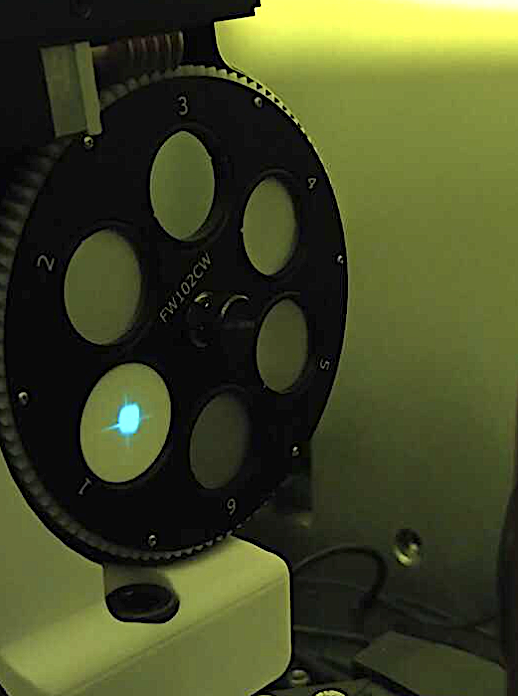
The experimental neutrino group at IFIC has extensive expertise in the detection of vacuum ultraviolet (VUV) light, developed within major international projects such as the DUNE collaboration and NEXT collaboration experiments.
To support this work, the group has established a dedicated dark clean room equipped with state-of-the-art instrumentation for photon detection R&D and characterization (link). This facility enables precise and controlled studies of light production, transport, and detection under conditions relevant to next-generation detectors.
Current research activities include the measurement of key optical properties of detector materials—such as transmittance, reflectance, and absorption—which directly affect both the quantity and characteristics of the collected light. In addition, the group investigates the performance and efficiency of photon collection systems, contributing to the optimization of detector designs for future experiments.
In particular, the reflectance of materials such as aluminum, copper, and stainless steel is key to understanding the capabilities of the DUNE collaboration Photon Detection System. We perform these measurements using controlled light in the 110–550 nm range. The picture below shows the incident light at 500 nm (used for alignment) on the reference sample, together with the other samples mounted on a sample exchanger.