
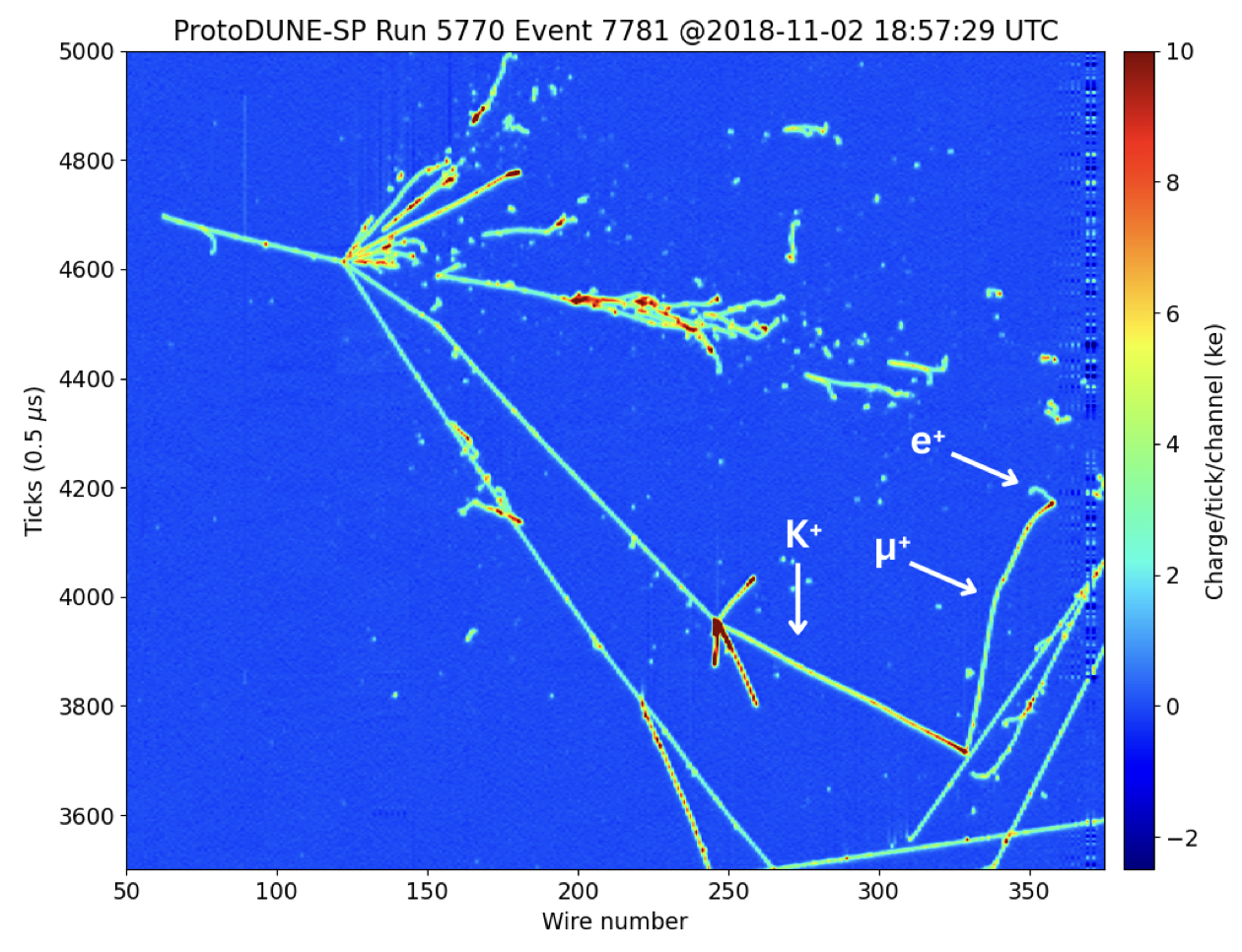
We are pleased to announce that our latest article, to be submitted to Physical Review D, is now available on arXiv. This publication is based on the PhD thesis of Miguel Ángel García Peris (link).
Abstract
The Deep Underground Neutrino Experiment (DUNE) is a next-generation neutrino experiment with a rich physics program that includes searches for the hypothetical phenomenon of proton decay. Utilizing liquid-argon time-projection chamber technology, DUNE is expected to achieve world- leading sensitivity in the proton decay channels that involve charged kaons in their final states. The first DUNE demonstrator, ProtoDUNE Single-Phase, was a 0.77 kt detector that operated from 2018 to 2020 at the CERN Neutrino Platform, exposed to a mixed hadron and electron test- beam with momenta ranging from 0.3 to 7 GeV/c. We present a selection of low-energy kaons among the secondary particles produced in hadronic reactions, using data from the 6 and 7 GeV/c beam runs. The selection efficiency is 1% and the sample purity 92%. The initial energies of the selected kaon candidates encompass the expected energy range of kaons originating from proton decay events in DUNE (below ∼200 MeV). In addition, we demonstrate the capability of this detector technology to discriminate between kaons and other particles such as protons and muons, and provide a comprehensive description of their energy loss in liquid argon, which shows good agreement with the simulation. These results pave the way for future proton decay searches at DUNE.
Leave a Reply